
The IPO lane will continue to be busy in December as 10 companies have lined up initial share-sale plans worth more than Rs 10,000 crore, merchant banking sources said on Wednesday. Moreover, the initial public offerings of Star Health and Allied Insurance and Tega Industries are currently open for public subscription. This comes after 10 firms successfully concluded their initial public offerings (IPOs) in November. Among the companies that scheduled their IPOs in this month include RateGain Travel Technologies, travel and hospitality technology services provider, and Anand Rathi Wealth Ltd, part of Mumbai-based financial services group Anand Rathi.

Acquisitions may have played a role in much of the increase.

Some companies argue that the culture of staying, working and learning at home will persist for a while, altering lifestyle habits of consumers.

The survey covered 1,210 IT executives and technology professionals from North America, the United Kingdom, Australia, New Zealand, Singapore and India. In India, 202 respondents from businesses with more than 500 employees across 18 industry verticals completed the survey. Overall, 89 per cent of the respondents said implementing a work-from-home policy had increased security challenges for their organisations. The risk posed by shadow IT was especially high, with 89 per cent of companies having no control over the software that employees purchase and install on their devices.

Leading FMCG companies in the country are expecting their sales growth numbers in high double digit in the April-June quarter, a period when the broader market was severely impacted by the second wave of the COVID-19 pandemic. FMCG companies such as Godrej Consumer Products Ltd (GCPL) and Marico, in their quarterly updates to bourses, informed about double-digit sales growth. While Tata Consumer Products Ltd (TCPL) MD and CEO Sunil D'Souza in an interview had told PTI, the Tata Group FMCG firm expects higher growth in the Q1/FY'22 over Q4/FY'21.

With automation taking place at a much faster pace across industries especially in the tech space, domestic software firms that employee over 16 million are set to slash headcounts by a massive 3 million by 2022, which will help them save a whopping $100 billion mostly in salaries annually, says a report. The domestic IT sector employs around 16 million, of them around 9 million are employed in low-skilled services and BPO roles, according to Nasscom. Of these 9 million low-skilled services and BPO roles, 30 per cent or around 3 million will be lost by 2022, principally driven by the impact of robot process automation or RPA. Roughly 0.7 million roles are expected to be replaced by RPA alone and the rest due to other technological upgrades and upskilling by the domestic IT players, while it the RPA will have the worst impact in the US with a loss of almost 1 million jobs, according to a Bank of America report on Wednesday.

Billionaire Mukesh Ambani's Reliance Retail on Thursday told the government that complex legal structures have been used by some firms to bypass the country's e-commerce rules which from the very beginning do not allow foreign capital in the inventory-based model. At a meeting called by the commerce ministry on allegations that foreign online retailers created complex structures to bypass foreign investment rules and damage small traders, Amazon urged the government not to issue any clarification until investigations into its business practices had been concluded, sources said. At the meeting, Reliance Retail's representatives said the Indian e-commerce policy does not allow foreign capital in the inventory-based model and foreign investment is allowed only in pure technical infrastructure/ platform that facilitates the meeting of buyer with sellers.

Capital dumping is being used by foreign e-commerce firms to subsidise and engage in predatory pricing, oil-to-telecom conglomerate Reliance Industries (RIL) has told the Associated Chambers of Commerce and Industry of India (Assocham) in an internal document. The document alleges that this is leading to massive unemployment and financial distress among small merchants and kirana stores. It consists of various recommendations and proposed changes that deal with Press Note 2 of 2018 (PN 2), which RIL wanted Assocham to present to the government, according to sources.

Beat the heat with a bowl of refreshing salad. Chef Ranjan, Executive Chef, Hotel Sahara Star shares his recipe.

As the deadly second wave of the Covid-19 pandemic rages on, startups and technology firms are realising the burnout effect it is having on employees. Many have shortened their work weeks to four days, while others have made provisions for more time off for employees to help them rejuvenate or care for loved ones.

To strengthen corporate governance practices and disclosure requirements, Sebi has notified new rules, including that top 1,000 listed firms will have to formulate a dividend distribution policy. The regulator has also put in place a framework in relation to applicability, constitution and role of the Risk Management Committee (RMC) and eased norms for re-classification of a promoter as a public shareholder, according to a notification dated May 5. In addition, the regulator has asked listed firms to make available audio and video recordings of analyst and investor meets on their websites as well as stock exchanges within 24 hours or before the next trading day and also notified rules regarding Business Responsibility and Sustainability Report (BSSR).

Markets regulator Sebi and the Directorate of Revenue Intelligence (DRI) are probing some Adani Group companies for alleged non-compliance with rules, the government told Lok Sabha on Monday. Minister of State for Finance Pankaj Chaudhary in a written reply to a question said accounts of three of the six Mauritius-based funds, that have invested most of their money in Adani Group firms, were frozen in 2016 over the issuance of Global Depository Receipt (GDR) by certain listed firms. No freeze was ordered for their holding in other firms.
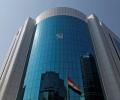
Growth-oriented technology companies have raised Rs 15,000 crore through initial share sales in the last 18 months and IPOs worth around Rs 30,000 crore by such firms are in the pipeline, Sebi chairman Ajay Tyagi said on Thursday. "Growing number of unicorns in the startup ecosystem is a testimony of the new age tech companies coming of age in our economy. These companies often follow a unique business model focusing more on rapid growth than immediate profitability," Tyagi said at an event organised by industry body CII. During the last 18 months, growth-oriented technology companies have raised a sum of around Rs 15,000 crore through IPOs (Initial Public Offerings).

A knee-jerk reaction, they said, could be detrimental to the fortunes of an industry that is highly dependent on the country given the huge competitive advantage it offers, in terms of cost and speed.

Total of 11 private Indian firms have made it to the list of 500 most valuable companies across the world, and the country is ranked 10th on the chart, as per a report. The total value of these 11 companies grew 14 per cent and has been pegged at $805 billion or nearly a third of the Indian GDP. All these companies in the list of non-state enterprises have gained in value during 2020, which was hit by the pandemic, barring tobacco major ITC and second largest private sector lender ICICI Bank, as per the 'Hurun Global 500' report.
Initial share sales are set to dazzle the Dalal Street in 2022 too as companies are expected to garner up to Rs 1.5 lakh crore in the New Year, continuing with the bullish momentum after 2021 turned out to be the best IPO year in two decades for the Indian market. Excessive liquidity and increased retail investor participation ensured a persistent euphoria in the Initial Public Offer (IPO) space wherein companies mopped up more than Rs 1.2 lakh crore this year even as pandemic gloom shadowed the broader economy. In 2022, the higher amount of funds through the primary market will be largely driven by the mega IPO of state-owned Life Insurance Corp (LIC).

Passenger vehicle wholesales in India declined by 66 per cent to 88,045 units in May as compared to April this year as lockdowns across various states impacted dispatches to dealers, auto industry body SIAM said on Friday. Passenger vehicle wholesales in April stood at 261,633 units. As per the latest data by the Society of Indian Automobile Manufacturers (SIAM), two-wheeler dispatches to dealers dropped by 65 per cent to 3,52,717 units, compared to 9,95,097 units in April.

Amid the reports of coronavirus vaccine shortage from various states, the central government and Hyderabad-based Bharat Biotech are willing to invite other companies which want to produce COVAXIN in a bid to scale up the vaccine production, said NITI Aayog member Dr VK Paul, on Thursday.

Meanwhile, with China switching its trading partners due to geo-political issues, increased trade with South Africa for bauxite and with the US for coal is also auguring well for vessels with tonne miles going up.

The composer thanked other artists for the making of the song.

The three Indian companies are Alpha Design Technologies Pvt Ltd, Bharat Forge Ltd and Medha Servo Drives Pvt Ltd, the space organisation said in a statement on Friday.
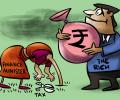
Ahead of the second instalment of advance tax, the revenue department is scrutinising entities that have registered negative growth in their tax deducted at source (TDS) payments, even when they reported healthy advance tax payments. According to sources, taxmen have observed a mismatch in TDS payments from at least 60-65 small to mid-sized companies. Officials said it is unusual for TDS to not increase, given the improved turnover and profits - if higher advance tax payments are any indication.

Seven of the 10 most valued domestic companies together added Rs 1,31,173.41 crore in market valuation last week, with HUL and TCS emerging as the biggest gainers. Reliance Industries, Infosys, HDFC, Bajaj Finance and Wipro also saw a rise in their market valuations, while HDFC Bank, ICICI Bank and SBI suffered losses. The market capitalisation (m-cap) of Hindustan Unilever Limited (HUL) zoomed Rs 50,234.21 crore to Rs 6,15,016.63 crore.

Eight of the top-10 most valued companies suffered a combined erosion of Rs 2,61,812.14 crore in market valuation last week, with Reliance Industries emerging as the biggest laggard. In the top-10 list, Infosys and Wipro were the only gainers. During the last week, the BSE benchmark slumped 1,774.93 points or 3.01 per cent.

The industry's operating margins will narrow by 0.30- 0.80 per cent largely on an increase in local hires which the industry has been forced into due to the policy framework in its markets.

Hectic fundraising through initial public offerings (IPOs) is expected in October-November, with at least 30 companies are looking to collectively raise over Rs 45,000 crore through initial share-sales, merchant banking sources said. Of the total fundraising, a large chunk would be garnered by technology-driven companies. The successful IPO of food delivery company Zomato, which was overwhelmingly subscribed by over 38 times, encouraged new-age tech companies to come out with their primary share-sales.


According to sources, government officials have asked industry bodies and manufacturers to submit key concerns and requirements to begin manufacturing activity.

The petroleum ministry has told ONGC to give away 60%stake plus operating control in India's largest oil and gas producing fields of Mumbai High and Bassein to foreign companies, according to an October 28 letter to the state-owned company. Amar Nath, additional secretary (exploration) in the Ministry of Petroleum and Natural Gas, wrote a 3-page letter to ONGC chairman and managing director Subhash Kumar, saying productivity of the Mumbai High and Bassein & Satellite (B&S) offshore assets under state-owned firm was low and international partners should be invited and given 60 per cent participating interest (PI) and operatorship. This is the second time since April that Nath, who is part of the ONGC management as the longest-serving government nominee director on its board and often considered a potential candidate to replace Kumar next year, has written an official letter, painting a poor picture of the company's performance.

The market capitalisation of BSE-listed companies jumped to a record high of Rs 2,40,04,664.28 crore on Tuesday, driven by a rally in stocks that also saw the benchmark Sensex touching its lifetime peak of 53,887.98 points. Rallying for the second consecutive day on Tuesday, the 30-share BSE index closed at a fresh closing peak of 53,823.36 points, a jump of 872.73 points or 1.65 per cent. During the day, it zoomed 937.35 points to 53,887.98 points.

Together with the firm's partly-paid shares that were issued in the recent rights issue and are traded separately, the company had a combined m-cap of Rs 13.5 lakh crore or over $181 billion.

To strengthen corporate governance practices and disclosure requirements, Sebi on Thursday decided that top-1,000 listed firms should formulate a dividend distribution policy.

While the recent volatility in the secondary markets is a concern, experts believe the sentiment towards IPOs is still buoyant.

Petrol price on Wednesday neared all-time high after state-owned fuel retailers hiked rates after a nearly month-long hiatus. Petrol price was raised by 26 paise per litre and diesel by 25 paise a litre, according to a price notification from oil marketing companies. After this increase, petrol in Delhi climbed to Rs 83.97 per litre from Rs 83.71 previously. Diesel rates rose to Rs 74.12 per litre from Rs 73.87. In Mumbai, diesel touched an all-time high of Rs 80.78.

Fund managers said investors remained positive on the pharma manufacturing activity in India, which further strengthened during the Covid-19 period, on account of restrictions imposed on pharma imports from China.
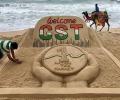
Businesses with monthly turnover of over Rs 50 lakh will have to mandatorily pay at least 1 per cent of their GST liability in cash, the finance ministry said as it moved to curb evasion by fake invoicing. The Central Board of Indirect Taxes and Customs (CBIC) has introduced Rule 86B in Goods and Services Tax (GST) rules which restricts use of input tax credit (ITC) for discharging GST liability to 99 per cent. "... The registered person shall not use the amount available in electronic credit ledger to discharge his liability towards output tax in excess of 99 per cent of tax liability, in cases where the value of taxable supply ... in a month exceeds Rs 50 lakh," the CBIC said.

Indirect emissions account for a major chunk of emissions by Indian IT firms. Business travel and commutation, together, are a key reason for it. If travel and daily commuting go down, so does carbon emissions.

The western world had largely considered India to be a production hub, and also, a good potential geography for clinical trials, and a big market. But in Covid-19 research, Indian companies and government researchers are also researching new drug candidates and potential vaccines, says Prosenjit Datta.

The court's directions mean that Lodha immediately ceases to hold all positions in the M P Birla group, including as director in the firms and other positions in the trusts and societies of the M P Birla group, a statement from the Birlas read.
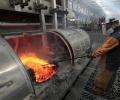
In the domestic segment, demand is currently led by rural markets, oil and gas, LPG and B2C segments like roofing and sheeting.
 © 2026 Rediff.com - Investor Information - Advertise with us - Disclaimer - Privacy Policy - Sitemap - Feedback - About us - Terms of use - Grievances